
Advice and inspiration
Why do hand-knotted rugs cost more than machine-made rugs?

A hand-knotted rug usually costs more primarily because every knot is formed by an individual movement of the hand and production cannot be accelerated like an automated line. The price includes more than time at the loom. Design, warp preparation, yarn selection and dyeing come before it; pile clipping, washing, drying, stretching, edge finishing and inspection follow.
A machine-made rug can repeat the same digital design across a large production run and distribute development and set-up costs among many pieces. This lowers the manufacturing cost per square metre. It does not automatically mean that every handmade rug is excellent and every machine-made rug poor. They are different production and pricing models.
What you are really paying for in a hand-knotted rug
A finished rug concentrates the work of several trades. Depending on the production, a designer may prepare a drawing or knotting cartoon; other workers select, grade, wash, spin and dye yarn, build the warp and prepare the loom. A weaver or team ties rows of knots, inserts the wefts, compacts the structure and continually checks the drawing.
When it leaves the loom, the rug is not yet ready for sale. The pile is clipped and levelled, the surface washed by an appropriate method, the shape stabilised during drying and stretching, the sides and ends finished, and dimensions, colour and faults checked. Some stages are straightforward; others require highly experienced hands. The price is the sum of the chain, not just the final knotting stage.
Manual time grows with area and fineness
The overall number of knots is affected by both the rug's area and knot density. Twice the area means roughly twice as many rows at the same construction, while finer drawing adds more knots within each part. Complex colour changes can slow the process further because the weaver selects and changes yarn more frequently.
Production time cannot be estimated reliably from a photograph or one universal number of days. It depends on loom width, number of weavers, materials, density, design complexity, working pattern and local tradition. The knotting of a large or extremely fine piece may take many months or longer; a simpler small rug is completed much more quickly.
Skill is a separate part of the cost
Knotting is not merely mechanical repetition. The weaver must maintain even warp tension, read the drawing correctly, change colours, insert wefts consistently and notice a shift in design or width before it spreads. Curves, figural motifs and subtle transitions demand greater precision than large geometric areas.
The transmission of the craft also has value. Traditional production depends on long apprenticeship in design, dyeing, knotting, clipping and tool or loom preparation. The buyer is not paying for the “imperfection of handwork”, but for the ability to create a stable structure and convincing design without every movement being controlled automatically.
Design and colour development carry costs
An original rug may begin with hand drawing, digital translation, trial samples and palette selection. Bespoke production involves approval of colours, materials and dimensions and sometimes several weave samples. For one piece or a short edition, those costs cannot be spread over thousands of products.
A traditional pattern does not mean that design adds no value. Motifs need to be scaled for the dimensions, fields and borders must join correctly, and the drawing must suit the available knot density. A poorly translated detail may remain unclear even in a very fine weave.
Materials can change the price substantially
Wool is not one uniform commodity. Fibre length and fineness, resilience, lustre, cleanliness, spinning and grading affect handle, drawing and durability. Hand-spun yarn requires extra work and naturally introduces small changes in thickness. Good silk or a high silk content usually increases cost, but the word “silk” alone does not guarantee sound construction.
Dyeing carries costs of its own. Preparing small colour batches, controlling the recipe, fixation, rinsing and drying the yarn consumes time and material. Natural dyes may involve complex preparation and mordanting; good modern synthetic dyeing requires precise chemistry and process control. The simple division of natural as expensive and synthetic as cheap does not always hold.
Finishing and quality control determine the result
After knotting, it becomes clear whether the rug holds a rectangular shape, the pile is even and the colours remain stable in washing. Sensitive clipping can clarify the drawing, while excessive clipping damages it. Unsuitable washing may alter the handle, start colour migration or conceal a problem with an artificial sheen.
A responsible workshop also allows for correcting small production faults, final measurement and documenting materials and origin. These steps increase cost but often decide whether the rug lies well and serves for a long time.
Why machine production costs less per piece
An industrial loom performs large numbers of repeated operations rapidly and under precise control. Developing the design, programme, yarn package and machine setting may be expensive, but a large run spreads that cost among many identical or closely related pieces. Automation also reduces the direct labour needed for each metre.
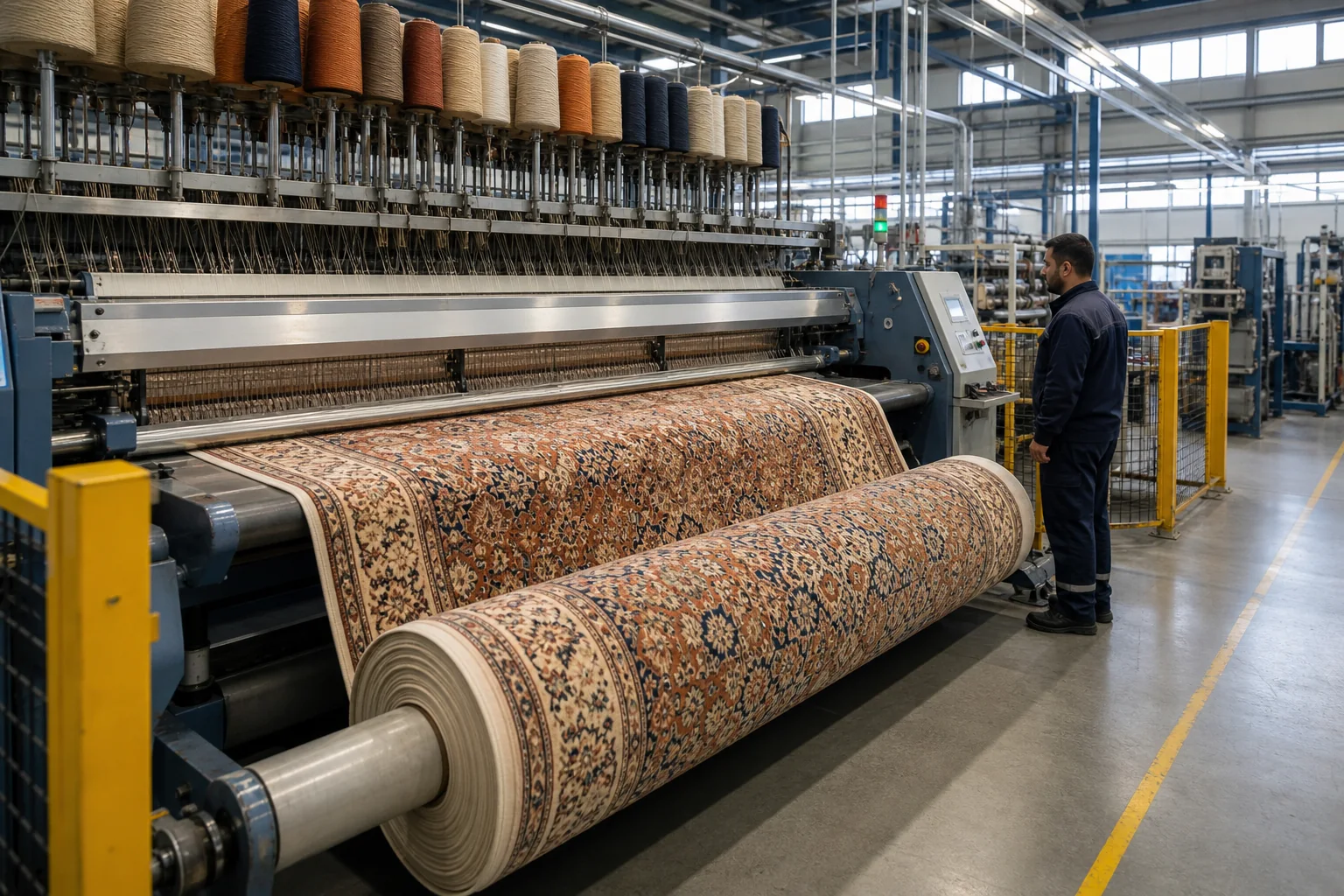
Machine production distributes design and set-up across a large run. Its advantages are speed, repeatability and a low share of labour per piece.
The manufacturer can repeat colours and dimensions accurately, optimise material use and continuously produce rolls or standard formats. A lower price does not therefore result only from cheap fibres; speed, capacity and economies of scale play a major role.
Hand-knotted and machine-made cost factors compared
| Cost area | Hand-knotted rug | Machine-made rug |
|---|---|---|
| Pile formation | Individual knots are formed by hand | The structure is produced by an automated or mechanised loom |
| Time per piece | High and strongly dependent on size and density | Far shorter after production is configured |
| Design | The cost is often spread over one rug or a small edition | The programme and pattern can be repeated in high volume |
| Dimensional consistency | Natural small variations of hand production | Highly precise repeatability |
| Materials | Often wool, silk and cotton; dependent on the individual piece | Natural and synthetic fibres according to the product line |
| Finishing | More separate hand stages and inspections | Greater standardisation and automation |
| Individuality | Each piece carries small differences from its making | Consistency across a series is an advantage |
Why hand-knotted rugs vary in price
- Size and density: greater area and finer structure usually mean more work, but density must be judged in the context of the rug type.
- Materials: wool quality, silk content, foundation construction and spinning can alter costs substantially.
- Design complexity: frequent colour changes and small curves need more concentration and time than large simple areas.
- Place and method of production: wages, workshop scale, local infrastructure, oversight and supply-chain length differ.
- Age, rarity and provenance: for historic rugs, price reflects condition, collecting significance and documented history as well as original manufacture.
- Condition and repairs: skilled restoration costs money, but extensive or poor intervention may reduce market value.
- Retail service: import, storage of large objects, photography, cleaning, expert description, home trials and guarantees have costs.
Knot count is therefore one element, not a complete formula. Two rugs of the same density may differ in wool, structural balance, dyeing, drawing, condition and origin. A price based solely on a marketing number is not a complete comparison.
A high price does not guarantee fair production
The retail price cannot by itself reveal how much reached the weavers or whether the complete supply chain is traceable. For contemporary production, ask about the particular workshop or weaving area, how work is commissioned, how labour conditions are monitored and whether independent certification is available.
It is equally important to understand what a certification actually verifies. A programme addressing child, forced and bonded labour does not automatically assess artistic quality, geographical authenticity or durability. Ethical conditions, construction quality and origin are separate questions, each requiring appropriate evidence.
When a machine-made rug makes sense
A machine-made rug may be a rational choice for a limited budget, temporary home, hotel or office project, very heavy traffic or a scheme requiring many matching pieces. It offers exact dimensions, repeatable colour and a broad range of constructions. A good product has a valid place and need not pretend to be handmade.
A hand-knotted rug suits a buyer who values individual drawing, material character, traces of craft, the potential for specialist repair and long-term use. It is not automatically an investment with guaranteed appreciation. Buy it first as a well-chosen functional and artistic object.
How to compare two offers
- Confirm whether each piece is hand-knotted, hand-tufted, hand-woven flatweave or machine-made.
- Compare exact dimensions, pile, warp and weft materials and country of manufacture.
- For a handmade rug, inspect the reverse, sides, fringes, density and structural consistency.
- Ask about dyeing, final washing, known repairs and recommended maintenance.
- For a historic piece, separate manufacturing quality from age, rarity, provenance and present condition.
- Find out what the price includes: delivery, underlay, home trial, specialist cleaning, warranty and returns.
- Do not decide solely from a high “original” price and a large percentage discount; compare the actual description and condition.
The useful question is not simply “why is this rug expensive?”, but “which specific costs and qualities explain its price?”. A trustworthy dealer can answer factually by describing manufacture, materials, origin, condition and service, rather than presenting a high price as proof of quality.