
Advice and inspiration
Where can I buy a genuine Persian rug without getting misled?

The safest place to buy a genuine Persian rug is a specialist hand-knotted rug retailer who lets you inspect the face and reverse, explains materials and construction, describes origin as precisely as the evidence allows and gives you a written record of what you are buying. A good purchase does not begin with asking whether a rug looks “Persian”; it begins with asking whether the seller can support the description.
In the strict sense, a Persian rug is made in Iran and is usually hand-knotted. In the market, however, the same look, pattern names and trade language may also be used for rugs woven elsewhere. Do not rely only on a label, photograph or romantic description. Verify construction, material, condition, plausible provenance and trading terms.
The safest setting: a specialist showroom
A specialist showroom gives you one important advantage: comparison. You can see wool and silk side by side, compare urban and village work, new and older rugs, and distinguish hand-knotted construction from hand-tufted or machine-made pieces.
Ask for the rug to be fully opened on the floor and shown from both pile directions. Colour and drawing can change noticeably with direction and light. A good seller will not prevent you from folding a corner and checking the reverse, fringe, sides, ends and any repairs. In fact, they should offer that inspection as part of the conversation.
Scale matters too. Photographs often distort knot fineness, pile height, sheen, colour temperature and small irregularities. A rug belongs in a real room, with real light and real traffic, so personal viewing remains extremely valuable.
What a trustworthy seller should be able to tell you
Not every rug will have archival provenance. For a normal new piece, however, a clear commercial description is reasonable. For an expensive, older or collectible rug, the description should be much more precise.
- Technique: hand-knotted, hand-tufted, kilim, soumak or machine-made.
- Pile material: wool, silk, a combination or another fibre.
- Foundation material: cotton, wool, silk or a blend.
- Origin: country, region, city, workshop or at least a probable type.
- Dimensions: actual measurements, including irregularities.
- Condition: wear, repairs, stains, shortened ends, replaced fringe or distortion.
- Terms: price, delivery, returns, claims, reservation and cleaning advice.
If the seller uses only broad words such as “genuine”, “luxury”, “handmade” or “antique” but cannot explain construction and condition, slow down. A serious dealer does not have to know everything instantly, but should be able to acknowledge uncertainty and check supporting information.
How to check that the rug is actually hand-knotted
Turn one corner over on a clean surface. On a hand-knotted rug, the design is normally visible on the back as individual knot nodes; it is not hidden under a broad adhesive layer and secondary cloth backing. Fringe often continues from the warp threads, so it is not merely a sewn-on decoration.
Look at the sides as well. A hand-knotted rug usually has edges formed from warps and binding that belong to the construction. Small variations in drawing, width or tension may be natural in manual work, while perfect mechanical regularity does not by itself prove hand knotting.
No single sign is absolute. An old rug may have repaired fringe, a protective lining or covered damage. Combine reverse inspection with material, origin, condition and written description.
A Persian design is not the same as Persian origin
Heriz, Isfahan, Kashan, Tabriz and Nain are names that may refer to real weaving centres, design types and trade styles. Many traditional Persian designs have been copied and are still copied outside Iran. A bold medallion, palmettes or a red-and-blue palette do not by themselves prove origin.
A sound attribution combines several layers: drawing, warp and weft materials, knot type, number and handling of wefts, side finish, pile, colours, size, age and comparison with documented pieces. For a valuable rug, have origin and condition assessed independently, especially if the purchase is presented as an investment or collectible.
Your purchase document should be specific
An invoice or receipt should contain more than a price. Ideally it records technique, materials, dimensions, approximate origin, condition and a way to identify the rug. For older or more expensive pieces, a separate report, photographs, repair notes and any available ownership history are helpful.
The word “certificate” alone does not guarantee much. What matters is who issued it, what facts it contains and whether it is tied to the specific rug. A certificate without measurable details, without a photograph or with only broad language should be treated as marketing support rather than independent proof.
For very valuable rugs, consider an independent appraisal or expert report before buying. The cost of checking is small compared with a mistake on a wrongly described or damaged piece.
How to buy online more safely
Online buying can work well when the seller provides enough information and real return terms. Ask for photographs of the full face, full reverse, corners, fringe, sides, stains and repairs. Colour should be shown in natural light and ideally from the opposite pile direction too.
The description should state actual size, material, construction, country or probable type, age or period, condition and delivery method. For a used or older rug, it is normal to request more detail than for ordinary new production.
Check that the store has traceable contact details, clear claim terms and a realistic return option. Avoid payment methods that give you no protection, and do not rush because of a “last piece today” message. A genuinely good rug can survive a calm decision.
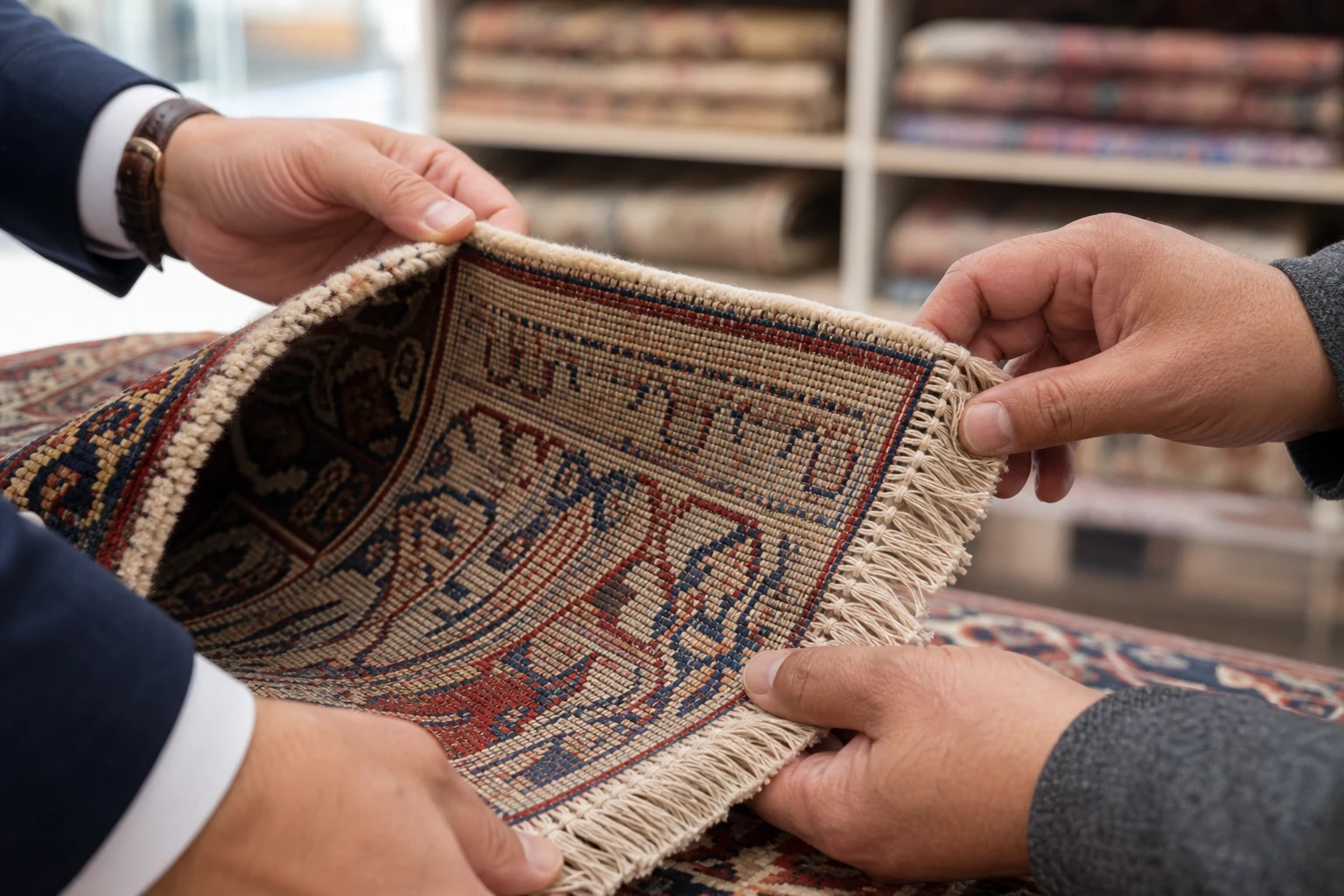
The most important inspection often begins on the reverse. Knots, fringe, sides and repairs tell you more than an attractive trade name.
Extra caution with auctions and second-hand listings
Auctions, classifieds and private sales can offer interesting rugs, but they carry more risk. Descriptions may be brief, condition may not be professionally assessed and returns can be limited. If you cannot judge construction, repairs and damage yourself, budget for expert inspection.
On older rugs, look for shortened ends, added fringe, re-bound sides, distortion, a hardened foundation, odour, old stains, insect signs, fading and local reweaving. Some repairs are normal and honestly done; the problem is when they are concealed or used to mask serious loss.
An auction hammer price is not automatically market value. Add buyer's premium, delivery, possible cleaning, repairs, duty or tax on international purchases and the risk that the rug cannot be returned.
Warning signs when buying
- the seller refuses to show the reverse, sides or damage details,
- every rug is described as “museum quality”, “investment grade” or “antique” without evidence,
- there is pressure to decide immediately,
- the seller cannot distinguish hand-knotted, tufted and machine-made construction,
- photographs are heavily edited or show only part of the face,
- the description omits material, size, construction and condition,
- the price is suspiciously low for a claimed silk or collectible rug,
- the certificate is generic and not tied to the exact rug.
How much information is reasonable to ask for?
For a new wool rug intended for normal interior use, exact technique, material, size, origin or type, price, return terms and practical care advice are enough. For an older Persian rug, a fuller condition report, repair history, age estimate and cleaning information are appropriate.
For silk, very fine weaving, antiques or an alleged investment purchase, ask for the highest level of specificity. If a large part of the value depends on origin, age or rarity, those facts need stronger support than a verbal assurance.
A quick comparison of buying channels
| Where you buy | Advantage | Risk | What to verify |
|---|---|---|---|
| Specialist showroom | In-person inspection, comparison and expert explanation | Higher price than anonymous sales | Description, origin, condition, returns and care |
| Trusted online shop | Convenient selection and wider range | Colour and scale can mislead in photos | Reverse photos, return terms and contact details |
| Auction | Chance of an interesting older piece | Limited warranty and hidden condition issues | Premium, condition, expertise and viewing options |
| Private sale | Sometimes a favourable price | Little documentation and weaker buyer protection | Construction, condition, true size and origin |
| Tourist purchase abroad | Experience and local availability | Pressure, shipping, returns and import rules | Documents, material, export and import conditions |
Practical checklist before payment
- Have you seen the whole rug opened, not only folded or hanging?
- Have you inspected the reverse, fringe, sides and ends?
- Do you know whether it is hand-knotted, tufted, flatwoven or machine-made?
- Are pile and foundation materials stated?
- Does the size work in the room, including space around furniture?
- Do you know the condition, repairs, stains and cleaning advice?
- Are return and claim terms written down?
- For an international purchase, have you checked current export, import and sanctions rules?
A genuine Persian rug should therefore be bought from someone with time, knowledge and willingness to show evidence. A good price is pleasant, but a clear description, honest condition, the chance to inspect and reasonable terms matter more for long-term satisfaction.