
Advice and inspiration
How can I tell if a rug is made of wool or silk?

You can often tell whether a rug is wool or silk by combining several clues: sheen, touch, pile resilience, fineness of drawing, reverse, fringe and overall construction. But no simple home test is completely reliable. Well-processed wool can be very fine, and some materials sold as “art silk”, viscose or bamboo silk can look shiny even though they are not real silk.
For ordinary browsing, these clues help you orient yourself. For an expensive, older or supposedly silk rug, do not rely on impression alone. Ask for the pile, warp and weft materials in writing, together with origin, size, condition and any known repairs. The value of a rug should rest on a clear description, not on one attractive word.
First ask which part of the rug is made from which material
A rug does not have to be made from one fibre throughout. It may have wool pile on a cotton foundation, wool pile with silk highlights, silk pile on a silk foundation, or a combination of several materials. So the best question is not simply “is it wool or silk?” A better question is: what are the pile, warp and weft made from?
The pile is the surface you walk on and the part that forms most of the visible design. The warp is the lengthwise foundation; its ends often become the fringe. The weft passes between rows of knots and stabilises the structure. These parts may differ, which is why a rug described as having “silk highlights” may be only partly silk.
How wool behaves
Good carpet wool is usually resilient, warmer to the touch and has a natural, softer lustre rather than a glassy reflection. When you brush the pile with and against its direction, the colour may change, but usually not as dramatically as with fine silk. Wool can feel fuller and more substantial, and the surface may show tiny fibres or a gentle fuzz.
Good wool is not automatically coarse. Some wool rugs are very soft, while others are firmer and more rustic. The difference can depend on sheep breed, fibre length, spinning, dyeing and pile clipping. Touch is useful, but it is not enough by itself.
How silk behaves
Real silk is usually smooth, fine, cooler to the touch and strongly directional in its sheen. When the light angle changes, the same area can look lighter or darker, almost as if the rug has turned around. Silk rugs also often allow very fine drawing and a lower, more compact pile.
Silk is not simply “anything shiny”. A plastic, harsh or metallic shine may suggest an artificial fibre. Some rugs are commercially described with silk-like words even when the material only imitates silk. It is therefore important to distinguish real silk from viscose, mercerised cotton and other shiny fibres.
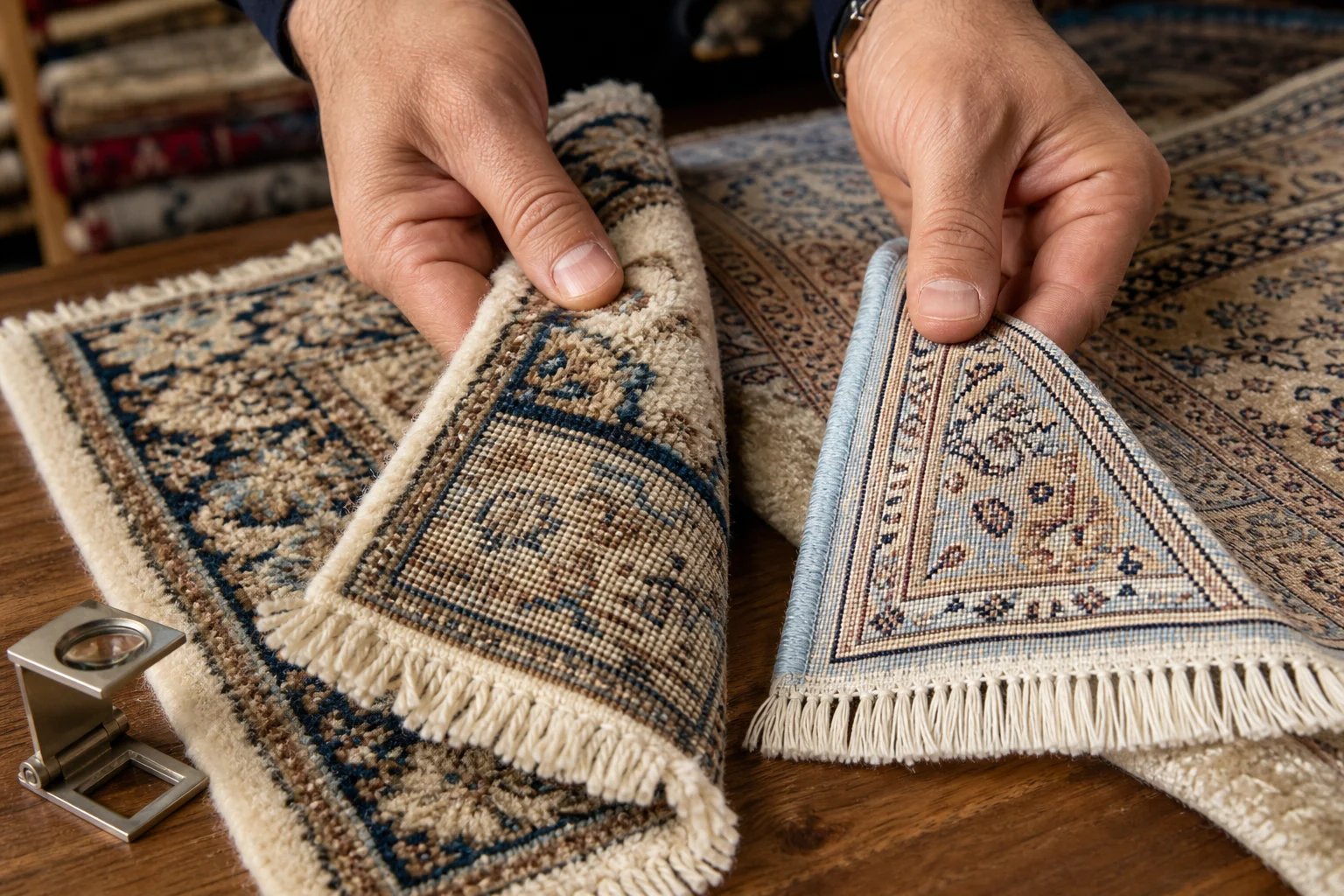
Sheen, pile thickness, reverse and fringe all give useful clues. Shine alone is not proof of real silk.
A simple comparison of clues
| Clue | Wool | Silk |
|---|---|---|
| Sheen | Natural, softer, less mirror-like | Strong directional sheen, major change with light angle |
| Touch | More resilient, warmer, sometimes slightly fuzzy | Smoother, cooler, finer |
| Pile | Often fuller and practical for regular use | Often lower, finer and better for calmer spaces |
| Drawing | Can be fine, but usually appears softer | Can allow very crisp lines and tiny details |
| Use | Living room, bedroom, more everyday traffic | Formal or quieter room, more careful handling |
| Risk of confusion | Very fine wool may look more luxurious than expected | Viscose and “art silk” can imitate shine |
Look at the reverse, fringe and knot detail
Turn a corner of the rug over and examine the reverse. On a hand-knotted rug, the design should remain readable from the back. A silk rug may have a very fine, regular reverse and thin fringe if the warp is also silk. A wool rug may have a more robust reverse, often with a cotton foundation and firm fringe.
Fringe can help, but it is not proof on its own. On some rugs, the fringe continues from the warp; on others, it may have been repaired or added. If a seller says the whole rug is silk, they should be able to explain whether the pile, warp and weft are all silk, or whether only some details are silk.
Use light and pile direction
Place the rug so daylight comes from one side. Brush the pile with your hand in one direction and then the other. With silk, the tonal change is often stronger and smoother; with wool, the change is usually softer and less sharp. Then view the rug from the opposite side of the room. A silk rug can change appearance dramatically.
This test is helpful, but not definitive. Some modern finishes, viscose fibres or very fine wool can mislead the eye. Always combine light, touch, reverse, fringe, price, origin and written description.
What not to do at home
Do not cut fibres from the rug, burn them with a lighter or apply chemical tests. These methods can damage the rug, create odour, change colour or reduce the value of a good piece. Without experience, the result is also easy to misread.
If the material matters to the price, have the rug assessed by a specialist. An expert can use magnification, construction knowledge, origin experience and, in some cases, laboratory fibre identification. For a valuable purchase, that kind of verification should feel like a normal part of a calm decision.
Questions to ask the seller
- Is the pile wool, silk, a blend or another shiny fibre?
- What are the warp and weft made from?
- Are only the design highlights silk, or is the whole pile silk?
- Are terms such as “art silk”, viscose, bamboo silk or mercerised cotton being used?
- Is the material written on the invoice or certificate?
- What cleaning and use does the seller recommend?
- Is the rug suitable for regular foot traffic or better for a quieter room?
What this means for choosing
A wool rug is often more practical for ordinary use, a family living room or any space where you want durability and easier care. A silk rug can be extraordinarily beautiful, fine and collectible, but it usually needs more careful placement, gentler handling and clear material documentation.