
Advice and inspiration
How can I incorporate a hand-knotted rug into a modern interior?

A hand-knotted rug does not belong only in a classical or historic interior. Its materials, drawing and small signs of handwork can be especially effective in a modern room. Clean contemporary furniture gives a traditional motif space to breathe, while the rug adds warmth, texture and a layer that keeps the room from feeling like a catalogue set.
The most important rule is simple: settle scale and function first, then choose colour and pattern. A beautiful rug that is too small, obstructs a door or cannot cope with the room's traffic will not look right, whatever its value.
Should the rug be the starting point or the finishing touch?
Both approaches work. If you already own a distinctive hand-knotted rug, let it form the basis of the scheme. Take one quiet neutral from it for larger surfaces and one or two secondary colours for smaller accents such as a cushion, ceramic object or artwork. There is no need to repeat every colour or match a shade precisely.
In an established modern interior, first decide what role a new rug should play. Is it to become the main picture on the floor, or a quieter layer that connects the furniture? In a minimalist room, a richly coloured Persian or Caucasian design can create a natural focus. If colourful art, a statement sofa or strongly veined stone already dominates the space, a rug with a calmer field and more restrained palette will often create better balance.
The right size matters more than the right style
An undersized rug looks like an isolated island beneath the coffee table and visually separates the seating. In a living room it should connect the main pieces: ideally the whole group stands on it, or at least the front legs of the sofa and chairs do. A comfortable border of rug should remain around the coffee table, not just a few centimetres.
Before buying, mark the proposed outline with low-tack painter's tape. Check walkways, door swings, floor sockets and the relationship with the architecture. Judge the size against the furniture group, not simply the total floor area. In a large open-plan room, one correctly proportioned rug can define a convincing living zone without a partition.
How to position a rug in each room
- Living room: place the front legs of the sofa and chairs on the rug so that the group reads as one. Where furniture floats away from the walls, having every leg on the rug can look more resolved.
- Dining room: allow the rug to extend roughly 75 to 90 cm beyond the tabletop on every side. Chairs then remain on one level when pulled out and their rear legs do not catch the edge.
- Bedroom: a large rug can sit under the bed and remain comfortably visible at the sides and foot. Two narrow runners may work better in a small room.
- Home office: account for the movement of chair feet or castors. A delicate high pile is unsuitable where a chair rolls constantly.
- Hallway: leave a visible floor border around a runner and make sure doors will clear it.
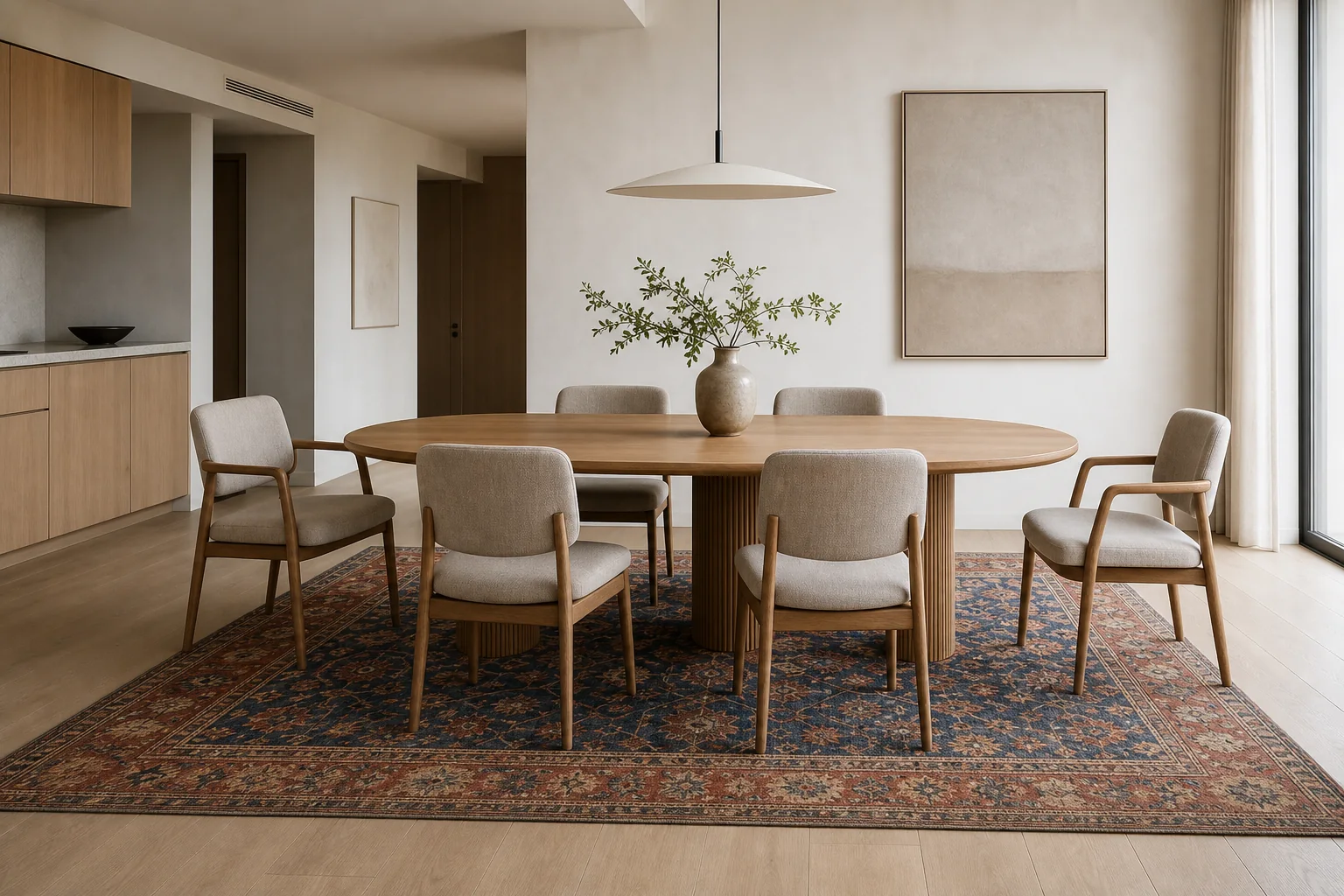
A dining-room rug must account not only for the table, but also for moving the chairs. Every leg should remain on the rug during normal use.
Contrast between old and new feels more natural than imitation
A traditional rug does not need Oriental accessories, heavy curtains or furniture from the same period around it. A modern sofa, simple timber table, metal frame and hand-knotted textile work together because their surfaces and ages differ. The result is not a themed room, but an interior that appears to have developed over time.
It helps to repeat a material or shape rather than a complete motif. A warm note in the wool might relate to timber, a dark outline to slender metal legs and a soft circular medallion to a rounded lamp or coffee table. These connections can be very subtle.
How to handle colour and pattern
The safest method is to divide the roles. Pair a strongly drawn rug with calmer large surfaces; with a simple rug, you can use more assertive art or textiles. Two complex patterns can coexist if their scales differ and they share one colour note, but every part of the room need not be filled.
Do not judge colour from a photograph alone. Wool and silk react to daylight and artificial light, while the apparent shade also changes with the direction of the pile. When possible, view the rug from both directions and at different times of day. A warm red or ochre may balance cool north-facing light; a calm blue, green or sand palette can feel fresher in a sunlit room.
Choose the construction for the traffic
| Space | What usually works | What to consider |
|---|---|---|
| Living room | Wool, low to medium pile, a size that connects the seating group | Heavy furniture feet and uneven traffic |
| Dining room | Firm construction and relatively low pile, with ample clearance around the table | Moving chairs, crumbs and spills |
| Bedroom | Less traffic allows a softer, more delicate piece | Edges hidden under the bed and access for maintenance |
| Entrance and hall | Durable wool, firm weave and a safe non-slip underlay | Heavy traffic, doors, moisture and outdoor dirt |
| Formal area | A finer or collectible rug away from the main route | Direct sunlight and pressure from heavy furniture |
A silk, extremely fine or historically important rug may look magnificent, but it is not automatically suitable beneath a dining table or in the main thoroughfare. A modern interior works better when decorative ambition is compatible with real use.
An underlay does more than stop slipping
A good underlay reduces movement, cushions pressure and protects the rug from small irregularities in the floor. It should suit both the flooring and the rug's construction, sit slightly inside the rug edges and never be folded or doubled. Unsuitable rubber, adhesive or a material that degrades over time may mark the floor or reverse, so inspect the underlay periodically.
Suitable furniture cups or pads can spread the load beneath heavy feet. It is also sensible to shift the furniture and rug slightly from time to time and rotate the rug where the room permits. Wear and light exposure will then be more even.
Protect the colours from direct light
Daylight brings colour to life, but prolonged direct sun can fade a textile and weaken its fibres. Near a large window, use blinds, curtains or another means of controlling the strongest light. Rotate the rug periodically and, when changing the layout, check whether an area previously concealed by furniture has developed a different shade.
Adapt routine maintenance to the pile and condition. Do not use a revolving brush until you know it is safe for the particular piece, do not pull the fringes into a vacuum and blot a spill without rubbing. Entrust the washing of a valuable rug or one with uncertain dyes to a specialist.
Can a hand-knotted rug be layered over another rug?
Yes, particularly when a favourite hand-knotted piece is too small for the complete seating group. It can lie over a larger, quiet, low-pile base. The lower layer resolves the scale and the upper one supplies the drawing. The edges must remain stable, however, and the combination must not create a trip hazard.
Layering can also integrate a vivid older textile into a very restrained interior. Choose a simple foundation without a competing pattern and leave a generous, preferably even, border around the upper rug.
The most common mistakes
- The rug is too small: it touches only the coffee table and visually pulls the furniture apart.
- Every colour is repeated exactly: the room feels arranged rather than naturally layered.
- Style becomes a theme: the traditional rug is surrounded by unrelated “Oriental” decoration.
- The decision is based on a photograph: actual colour, pile direction, handle and pattern scale are ignored.
- Traffic is forgotten: a delicate piece ends up beneath a castor chair, beside the entrance or in fierce sun.
- There is no suitable underlay: the rug slides, ripples or suffers unnecessary stress on the reverse.
A practical process before buying
- Measure the furniture and clear routes, then sketch the arrangement.
- Mark the rug dimensions directly on the floor with tape.
- Decide whether the rug should calm the space or become its main feature.
- Choose the construction for the traffic, children, pets and likely maintenance.
- View the colours from both pile directions and in natural light.
- Check door clearance, edge stability and the appropriate underlay.
- Photograph the room and bring its dimensions when viewing rugs in person.
A hand-knotted rug does not need to “match” a modern interior perfectly. It should enter into a conversation with it: unite the proportions of the furniture, add material contrast and introduce colour that will continue to feel right as the room is used. When scale and function are correct, the difference between traditional drawing and contemporary furniture becomes an advantage.